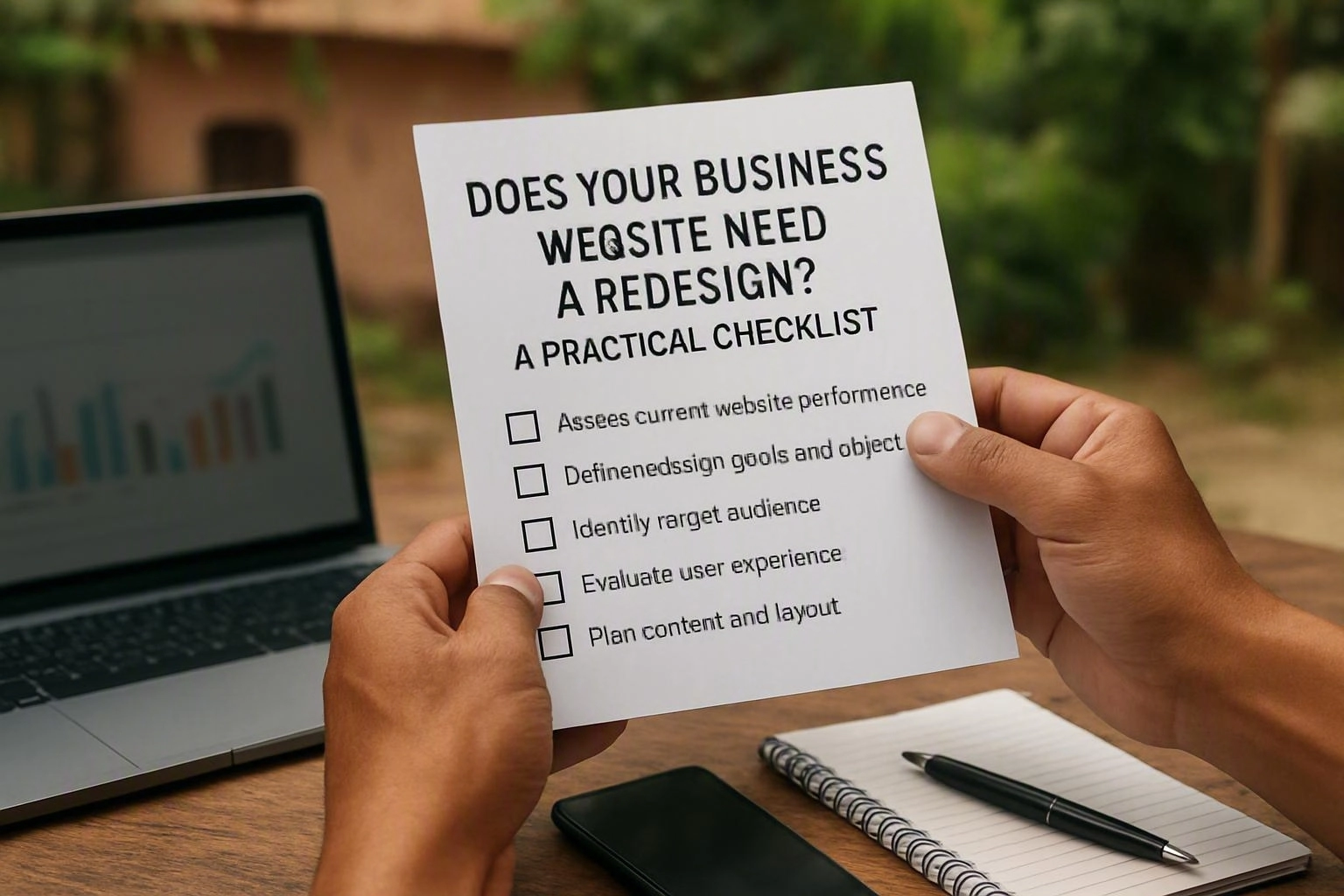
Does Your Business Website Need a Redesign? A Practical Checklist
A business website needs a redesign when its design, speed, mobile use, accessibility, or lead paths stop meeting business goals. Review analytics, technical SEO, Core Web Vitals, security, content, branding, and conversion paths first. Redesign only the areas causing clear problems, then protect useful URLs, test the new site, and track results after launch.
A business website should help the right visitor understand the offer, trust the business, and take the next step. Thinkwebhub helps teams review these goals before they invest in a site refresh. We use evidence instead of chasing design trends.
For a service business, useful evidence includes enquiry forms, consultation requests, phone enquiries, quote requests, and downloads. A page may look polished, but it can still fail. Visitors might miss the right service, abandon a form, or wonder what happens next.
The main choice is simple. Can focused website optimizationremove the problem, or does the site need a wider overhaul?
Our team may support Website Development in Bhubaneswar when a business needs design, content, technical, or integration work. The right web development company should first understand the goals, platform, and measurable problems.
Author: Debasis Sahoo
What Are the Signs That Your Business Website Needs a Redesign?
A business website needs a redesign when poor navigation, slow performance, weak mobile use, accessibility barriers, security issues, or falling conversions block important tasks. Other signs include rising abandonment, fewer qualified leads, uneven branding, old content, and difficult page updates.
Start with the user experience, not the appearance. Can a new visitor identify the audience, understand the value, find proof, and contact the business easily? Compare completed tasks with abandoned journeys in analytics and session recordings where appropriate.
A falling conversion rate matters, but it doesn't prove that every page needs rebuilding. Check traffic quality, campaign changes, form tracking, sales follow-up, pricing, and competitor activity. If qualified visitors still face the same problem, a conversion-focused redesign may help.
Technical SEO can expose deeper issues. Sometimes the platform works well, and only a template, landing page, or menu needs attention.
Look for patterns across devices and audiences. A site may work for staff on desktop but fail for mobile visitors or screen-reader users. Design decisions should connect to leads, accessibility, performance, and business results.
Quick Red Flags That Should Trigger a Website Review
How Do I Know if My Website Is Outdated?
A website may be outdated when its design no longer fits the brand, mobile tasks are difficult, content is wrong, accessibility is weak, or security updates are unavailable. A limited content management system can create the same problem. Compare the site with user needs, competitors, analytics, and current technical requirements.
Web design trends offer only one clue. An old visual style matters when it makes the business seem inactive or hides key information. Review logos, colours, photography, typography, tone, and calls to action across the site.
Test the content management system with normal tasks. Can a trained staff member update a service page, publish an article, replace an image, or fix a form safely? A legacy CMS may make simple edits slow, while a newer platform may still be poorly set up.
Check accessibility with keyboard navigation, colour contrast, labels, heading order, focus states, captions, and readable language. Security needs the same care. Unsupported plugins, old software, weak access controls, missing backups, and unavailable patches create risk.
Most review projects take between one and three weeks. The exact time depends on site size and access. Reviews often give better answers than site age alone. An older site may work well, while a newer one may have serious structural problems.
Before Redesigning: What Should You Check First?
A website audit should come before redesign work. Check business goals, analytics, search performance, conversion tracking, landing pages, backlinks, indexed URLs, content, technical SEO, accessibility, security, integrations, and user feedback. This shows what to keep, repair, combine, or rebuild.
Record the current experience before making changes. Our team groups findings into business, user, content, platform, and search areas. This makes it easier to approve a focused refresh or support broader website development.
Pay close attention to old CMS platforms, unsupported extensions, hosting limits, and inaccurate analytics. The redesign plan should state what will be moved, rewritten, redirected, tested, or removed.
Should You Redesign a Website That Is Slow on Mobile or Losing Conversions?
A slow mobile website needs quick attention, but it doesn't always need a complete redesign. First check hosting, code, images, scripts, templates, and third-party tools. A redesign makes more sense when slow performance joins poor mobile use, confusing journeys, outdated templates, or falling conversions.
Measure speed on important mobile templates, not just the homepage. Review Core Web Vitals, server response time, image formats, unused code, caching, font loading, redirects, and external scripts. A heavy booking widget or chat tool may cause more trouble than the visual design.
Conversion rate optimization should start with the visitor's task. Test clearer headlines, shorter forms, stronger proof, better error messages, visible contact options, and more useful landing page content. Tracking should separate qualified leads from spam and incomplete submissions.
For service businesses, compare enquiry quality, not only enquiry numbers. If leads are poor because services are unclear, content and site structure may need work. If forms fail because of hosting or integration faults, a focused repair may be enough.
A mobile-first redesign fits when the current framework can't support responsive design, accessible components, efficient templates, or reliable testing. It may be unnecessary when a few large images, plugins, or hosting settings cause the issue. Choose the smallest change that can improve results.
During the Redesign: Which Website Elements Must Be Protected?
Keep important URLs or map them with 301 redirects. Retain useful metadata and structured data, test forms and integrations, check responsive layouts, and launch only after staging tests confirm usability and crawlability.
Our team treats content migration as a planned project, not a quick copy-and-paste task. Keep pages that attract visitors, earn links, support sales, or answer customer questions. Rewrite weak content when needed, and record each change.
Don't let a temporary no-index rule, password gate, broken canonical tag, or missing redirect plan reach production. Record the launch checklist, rollback option, owners, and approval points before release.
How Can You Decide Between Optimization and a Full Redesign?
Website optimization is often enough when the platform, structure, and design system can still change easily. A full redesign fits better when the CMS, templates, site structure, accessibility, security, or mobile framework creates repeated problems. Choose the smallest change that can meet the business goal.
Use the table as a guide. Consider risk, staff skills, technical debt, customer impact, and return on investment. Visual preference shouldn't decide the project alone.
| Situation | Likely intervention | Reason |
|---|---|---|
| A few slow images or scripts | Website optimization | The existing templates may still work well. |
| Confusing forms on otherwise useful pages | Conversion-focused improvement | Test the journey before replacing the site. |
| Unsupported CMS or plugins | CMS migration | Security and maintenance limits affect the whole system. |
| Poor mobile framework and repeated template faults | Full redesign | Small fixes may not solve the main structure. |
| Strong content but dated presentation | Design system refresh | Keep the content while improving consistency and ease of use. |
Website development should focus on a clear result, such as faster mobile journeys or better qualified enquiries. A smaller project may give better value when it fixes the real problem. A larger rebuild may work better when maintenance, security, or platform limits make repeated repairs wasteful.
After Launch: How Do You Validate the Redesigned Website?
A redesigned website should be checked through technical, usability, and business measures after launch. Confirm indexability, redirects, speed, accessibility, forms, analytics, and security first. Then compare traffic, rankings, engagement, qualified leads, and conversion rates with the old baseline.
Launch day is a checkpoint, not the end. Our team recommends a review right after release. Regular checks should follow as users, crawlers, campaigns, and integrations use the new site.
Some changes may appear while search engines recrawl pages and users learn new paths. Investigate sharp losses quickly, but judge the project by qualified enquiries and completed goals too. A regular maintenance plan helps prevent the site from becoming outdated again.
Questions About Web Development Company
What Are the Signs That a Business Website Needs a Redesign?
Common signs include confusing navigation, poor mobile responsiveness, slow page speed, outdated content, weak accessibility, security problems, broken integrations, uneven branding, and fewer qualified enquiries. Review analytics and user feedback before choosing focused fixes or a complete rebuild.
How Do I Know if My Website Is Outdated?
Your site may be outdated if content is wrong, the design no longer fits the brand, mobile tasks are difficult, accessibility features are missing, or security updates aren't available. A difficult content management system can also cause problems.
Should I Redesign My Website if It Is Slow on Mobile?
Not always. First test hosting, images, code, scripts, templates, and third-party tools. A redesign is more suitable when slow mobile performance joins poor responsive design, confusing journeys, old templates, or a framework that can't meet Core Web Vitals targets.
Does a Declining Website Conversion Rate Mean I Need a New Website?
No. Check traffic quality, campaign changes, tracking accuracy, sales follow-up, form errors, offers, and competitor activity first. If focused improvements don't fix repeated usability or trust problems, a conversion-focused redesign may be justified.
What Should I Check Before Redesigning My Website?
Complete a website audit covering goals, Google Analytics, Google Search Console, conversion tracking, landing pages, backlinks, indexed URLs, technical SEO, content, accessibility, security, integrations, hosting, and user feedback.
Need help choosing between a site refresh, focused optimization, or a complete web redesign? We can review your goals, platform, mobile performance, search assets, and lead paths before recommending the next step.
Related Resources
Cheap Web Development Company Mistakes: What to Check Before Hiring
mistakes to avoid when hiring a cheap web development company
What to AvoidWebsite Development Project Scope Mistakes That Cause Delays and Extra Costs
common website development project scope mistakes
What to AvoidWebsite SEO Mistakes to Avoid Before Launch
What to AvoidMobile App Development Mistakes to Avoid Before Building an App
mobile app development mistakes to avoid